Posts

Showing posts with the label 48 Preludes & Fugues Opus 2

48 Preludes & Fugues is released!

Image
Dear all, I would like to release the original composition of 48 Preludes & Fugues album by Chitpong Kittinaradorn, containing 24 pairs of preludes and fugues in all major and minor keys for piano. Please enjoy them on SoundCloud: Episode 1: No.1-12 is omitted because of the lack of storage space. Episode 2: No.13-24 Episode 3: No.25-36 Episode 4: No.37-46 If you would like the audio files and the booklet, please let me know via contact found in the last page of the booklet!
Preludes & Fugues Opus 2: Fugue in B minor

Image
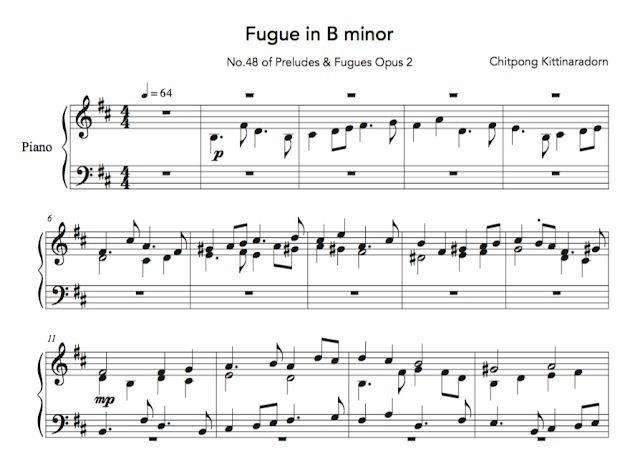
The final fugue and the final piece of 48 Preludes & Fugues. This is the music that is truest to my consciousness, worthy of being an ending piece of this year-long effort. Fugue in B minor is a four-part double fugue with four episodes. Each subject comprises two episodes. At 5:21 minutes, it is the longest piece in the set, containing the highest note and the lowest note. It also features all fugue-specific techniques (that I know of): stretto, false entry, diminution, and double exposition.

Preludes & Fugues Opus 2: Prelude in B minor

Image
The last prelude. The prelude that ends them all. In Episode 4, my aim is to pursue 'True Music' – a music that is true to the heart, without meaningless sentences or unnecessary adornment. This prelude is the culmination of this approach, the truest possible piece of art. It is simply a fantasy in five parts, with stark but clear soundscape. It also works to pre-orient listeners to the gravity and seriousness of the last fugue.

Preludes & Fugues Opus 2: Fugue in B major

Image
The last fugue in major key, closely related with the prelude. A happy farewell to living things that have grown and blossomed into intricate and beauty beings.

Preludes & Fugues Opus 2: Fugue in B-flat minor

Image
Fugue in B-flat minor continues on a theme of requiem. However, it sits at the very opposite end of the requiem prelude no.43 in term of the strictness of form. While the prelude was constructed on a very rigid passacaglia form, this fugue could rather be a fantasia. It is very fluid, the forms are there, but they are not obvious. There are form inside form, for example, a passacaglia episode inside a fugue, which use fugue subject as melodic variations on the fixed bass pattern. The fugue is also highly dissonant, and perhaps generally not pleasing especially when listen for the first time. In fact, I intentionally avoid many 'cliche' and opt to use unconventional meter, melodic motive, harmonic progression, and texture. I wanted to push the boundary of fugue further. It's the sound that's above earth, and possible, beyond human.

Preludes & Fugues Opus 2: Prelude in B major

Image
The last prelude in major key of Preludes & Fugues. A farewell ballad in a loose binary AB form. This is as simple it it could be.

Preludes & Fugues Opus 2: Prelude in B-flat minor

Image
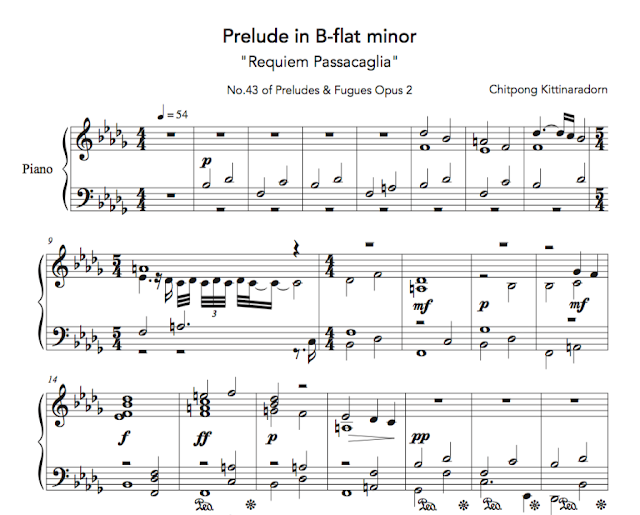
A prelude written in the passacaglia style. It is a set of eight variations over an eight-note bass pattern. The pace is very slow and deliberate. I could not call this piece with any other name except a requiem.

Preludes & Fugues Opus 2: Fugue in B-flat major

Image
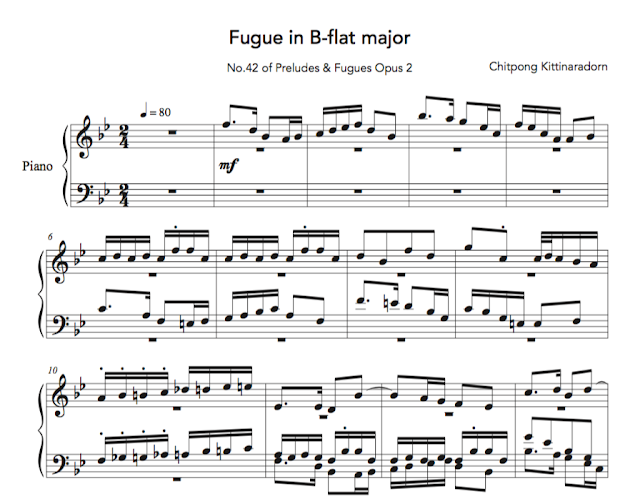
A fun and a bit raucous fugue. A last exuberant sprint before an inevitable decay.

Preludes & Fugues Opus 2: Prelude in B-flat major

Image
A miniature prelude. Light on the mood, yet maintaining sophisticated melodic arrangement especially in the balance, symmetry, and layering. An offering like a small and delicate dessert.

Preludes & Fugues Opus 2: Fugue in A minor

Image
A three-part fugue in grave, serious tone. It's simple and sparse, yet maintain fugal devices and complexity. There is a feeling of unstoppable gravitation that pulls one into something, whatever it is that would depend on a listener. This fugue is composed straight in one day. In term of structure, there is a small deviation from the strict requirement in the exposition part. In one voice I replace the Counter Subject with a free counterpoint. It is needed for aesthetic reason – to represent the progression and development of the theme more musically. This is the first time that I deviate from the strict requirement of the exposition part.

Preludes & Fugues Opus 2: Prelude in A minor

Image
A minimal and very short prelude. A contemplation and a rest, to pause and clear up for the things to come – the fugue in A minor.

Preludes & Fugues Opus 2: Fugue in A major

Image
A lively and refreshing fugue. It is very difficult to play because of the speed and complexity. It is a piece of festive mood. A thoroughly positive outlook. Playful yet thoughtful, with a relentless drive forward.

Preludes & Fugues Opus 2: Prelude in A major

Image
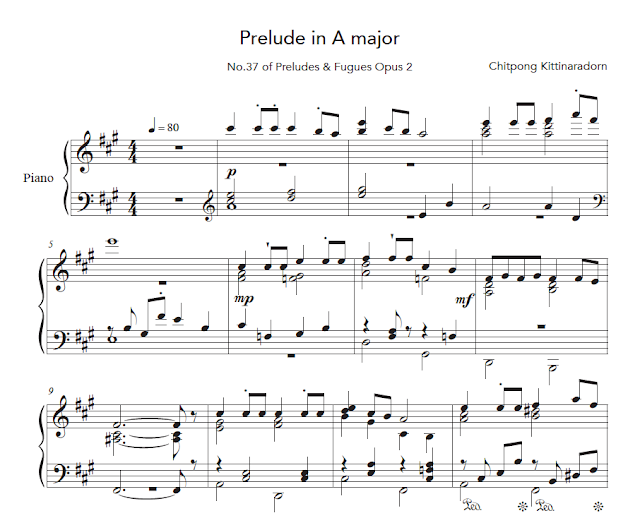
The first prelude of Episode 4. A simple, straightforward piece without any pretension. A direct portrayal of a state of being and a state of mind. This is the final version that has a revised main melodic motive because one of the listener kindly pointed out that the original melody was similar to a well known country song, which was a pure coincidence.

Preludes & Fugues Opus 2: Fugue in G-sharp minor

Image
The last fugue of Episode 3. A non-traditional fugue because the subject and its musical idea are based not on a melody but a rhythmic pattern – the same device Beethoven famously used in Symphony No.5. This fugue does not please its listeners. It has a feeling of being unsetling and unfinished. It literally asks for a resolution in Episode 4 which will be the last episode of Preludes & Fugues.

Preludes & Fugues Opus 2: Prelude in G-sharp minor

Image
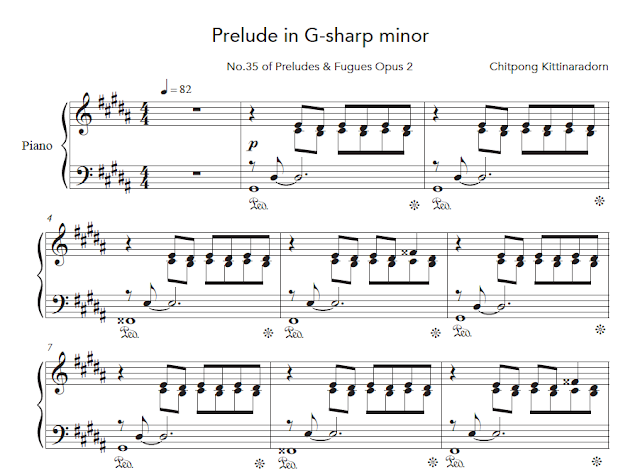
A modern and minimal prelude on an unusual key of G-sharp minor. A contemplation on a repetitive, unending nature of being. This is the last prelude of Episode 3.

Preludes & Fugues Opus 2: Fugue in A-flat major

Image
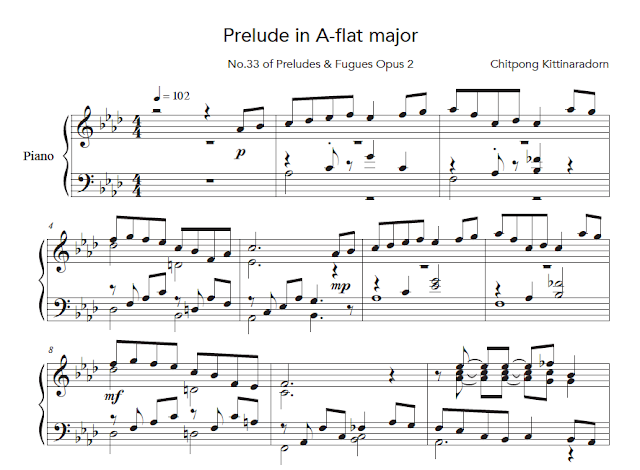
A fugue that is barely a fugue. The structure and style are more similar to chamber music of classical period, with some hint of Italian keyboard solo style. Altogether this is one of the more experimental work. The musical content is a continuation of Prelude in A-flat major No.33: A simple, lively theme is now developed to face the harsh reality, leading to a resolution and come back to the purity.

Preludes & Fugues Opus 2: Prelude in A-flat major

Image
Back to a simple, flowing and relaxing prelude with this Prelude in A-flat major. A comeback to an innocent mind after these all seriousness of lives.

Preludes & Fugues Opus 2: Fugue in G minor

Image
A highly abstract, academic fugue. The pattern is very steady and symmetrical, with special focus on imitation of voices, either obvious or hidden. Although it is very stoic in structure, this fugue is at the same time one of the most expressive piece that I have written. It contains so many feelings, many contrasting yet connecting emotion, all presented in a very steady, predicative way. It can be viewed as in pair with Fugue in F# minor No.28 because both share the same steady basic rhythm and stoic nature. You can call No.28 the brother because it is more forceful, more direct; and this Fugue No.32 the sister as it is more 'feminine', more expressive.

Preludes & Fugues Opus 2: Fugue in G major "Homage to Dhamma"

Image
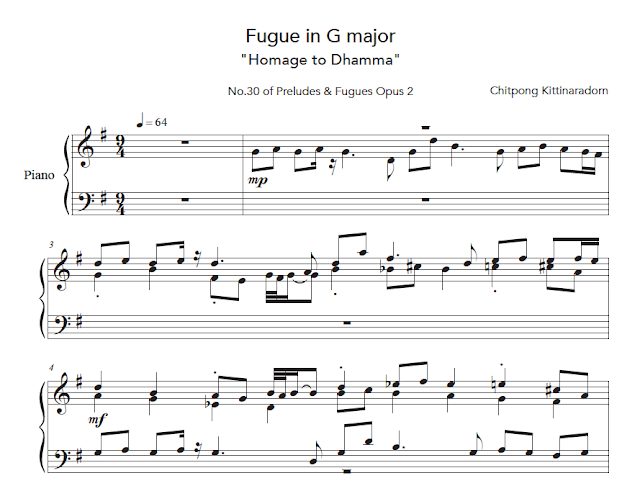
A special fugue on the verse of a Buddhist chant: Homage to Dhamma (บทสรรเสริญพระธรรมคุณ). Composing a classical music based on traditional prayer chant melodies is incredibly difficult. Melodies tend to be monotonous and repetitive. There needs to be deviations from the original melodies, not to mention musical development which adds further to the departure. As the piece develops, there is some point that the piece becomes almost unrecognisable, therefore a composer has to bring back the original 'tune' into the developed and departed music. This piece is a loose interpretation of the original melody. It is however filled with symbolic meanings which are very open to personal interpretation. It is pure music and applied music at the same time. At least this is what I hope has accomplished with this one.

Preludes & Fugues Opus 2: Prelude in G minor

Image
There is a romance and there is a way to release its blinding power by shining a light into it through musical composition. This prelude is doing just that.